
Kingweston (2), Somerset
(near Cedar Walk Plantation and Kingweston House)
Introduction: This crop circle was first reported on the 21st of June 2026 (Summer Solstice). It is in a field of young wheat. It measures approximately 180ft in diameter.
Location details:Google Maps Link OS Grid Ref: ST 52135 31746. What-three-words:tech.unfilled.suitcase
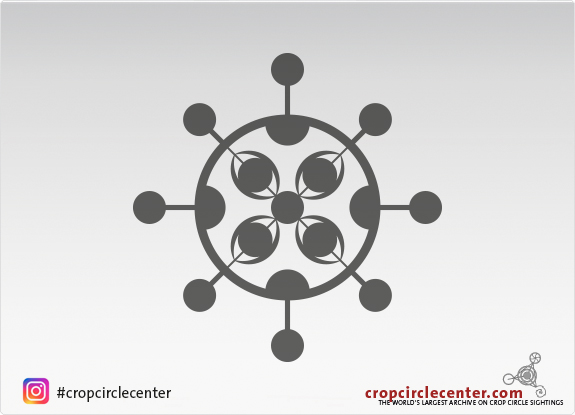
Description: This was an eight-fold design, with lollipop motifs and four eye-shapes in the centre.
Flight: We were able to get in the air and fly over this circle. We made it just before the thunderstorms set in, in the late afternoon. We literally had the last ten minutes of sunshine for the day. In the coming days we hope to have further images and some ground details, so please check back.
We are still fund-raising to fly this season, if you’d like to make a donation to our flight fund, you can do that here.
Visiting: Important – DO NOT ENTER THE FIELD. The farmer has asked people not to enter the field. Please respect his wishes. It would be good if the farmer doesn’t feel the need to cut it out. Please read our downloadable PDF about visiting the crop circles responsibly.
Location History: There have been several formations in this area just this year. Look for the beautiful All Saints Church in the pictures below, next to Kingweston House.
General Information:
Visiting the Circles? If you are thinking of visiting any crop circles this summer, please read our Visiting the Crop Circles section. It’s full of useful information and etiquette for visiting the countryside and the crop circles. Please remember that you should not enter any field without the express permission of the farmer.
Click here for Copyright Information about the reproduction of images on this website.
Please Help to keep us Flying in 2026: We hope to take to the skies again in 2026 to record the circles that appear this summer. If you have enjoyed looking at our pictures and information please consider making a small donation to keep us flying. There are so few of us left regularly recording the circles it’s really important that we continue. And while some now use drones to record the circles, it is important that there are still images taken from aircraft where the best quality camera equipment can be used and images that include the broad vista of the landscape can be taken. This kind of photography is expensive and it gets harder with each passing year to raise the funds we need to continue our work, but if everyone who regularly looked at this website made a small donation we would meet the funds we need. You can make a donation here.
NOTE: Some of the images below are beautiful landscape scenes. Click on each image to enlarge them and see the whole picture.
General Information:
Visiting the Circles? If you are thinking of visiting any crop circles this summer, please read our Visiting the Crop Circles section. It’s full of useful information and etiquette for visiting the countryside and the crop circles. Please remember that you should not enter any field without the express permission of the farmer.
Click here for Copyright Information about the reproduction of images on this website.
Please Help to keep us Flying in 2026: We hope to take to the skies again in 2026 to record the circles that appear this summer. If you have enjoyed looking at our pictures and information please consider making a small donation to keep us flying. There are so few of us left regularly recording the circles it’s really important that we continue. And while some now use drones to record the circles, it is important that there are still images taken from aircraft where the best quality camera equipment can be used and images that include the broad vista of the landscape can be taken. This kind of photography is expensive and it gets harder with each passing year to raise the funds we need to continue our work, but if everyone who regularly looked at this website made a small donation we would meet the funds we need. You can make a donation here.
NOTE: Some of the images below are beautiful landscape scenes. Click on each image to enlarge them and see the whole picture.
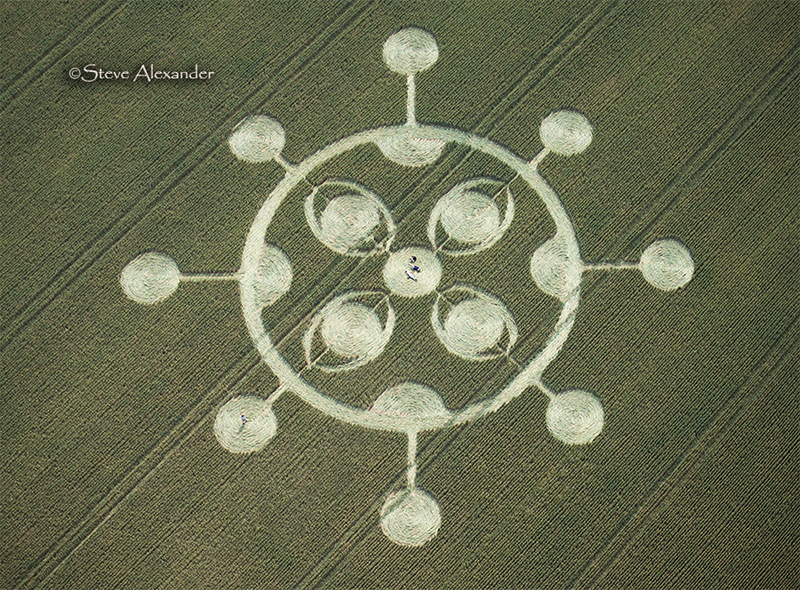
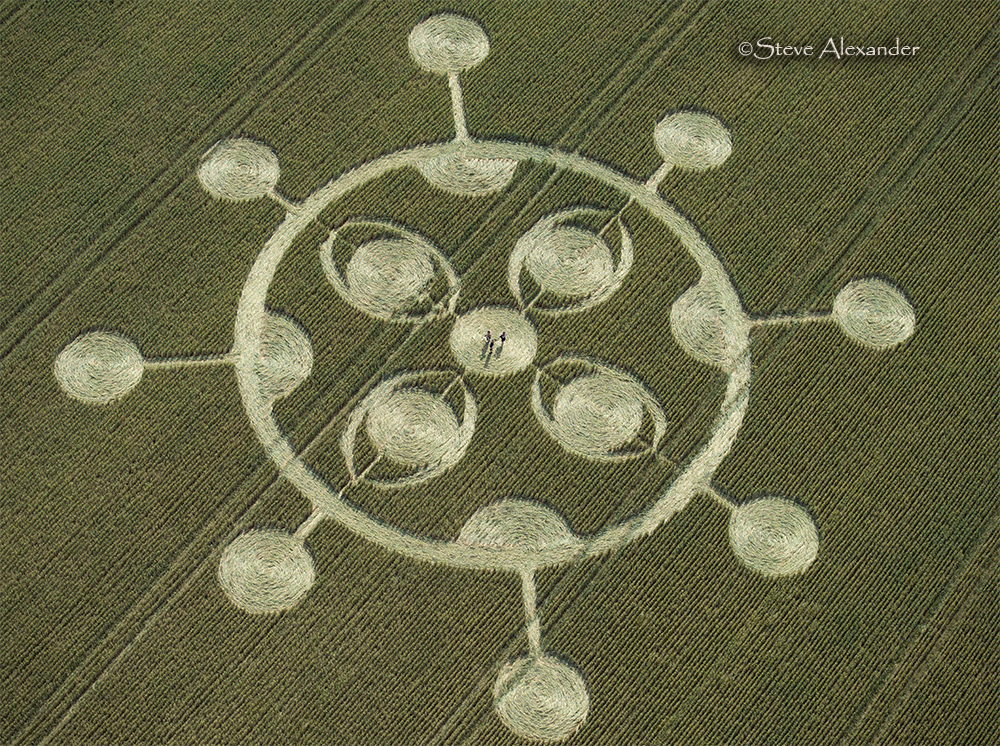
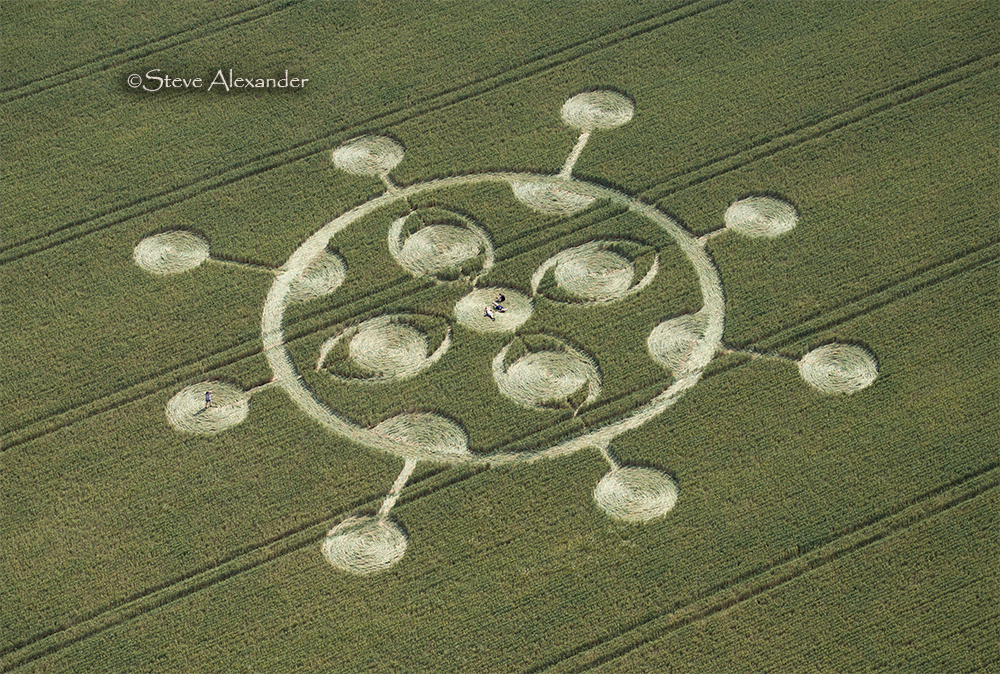
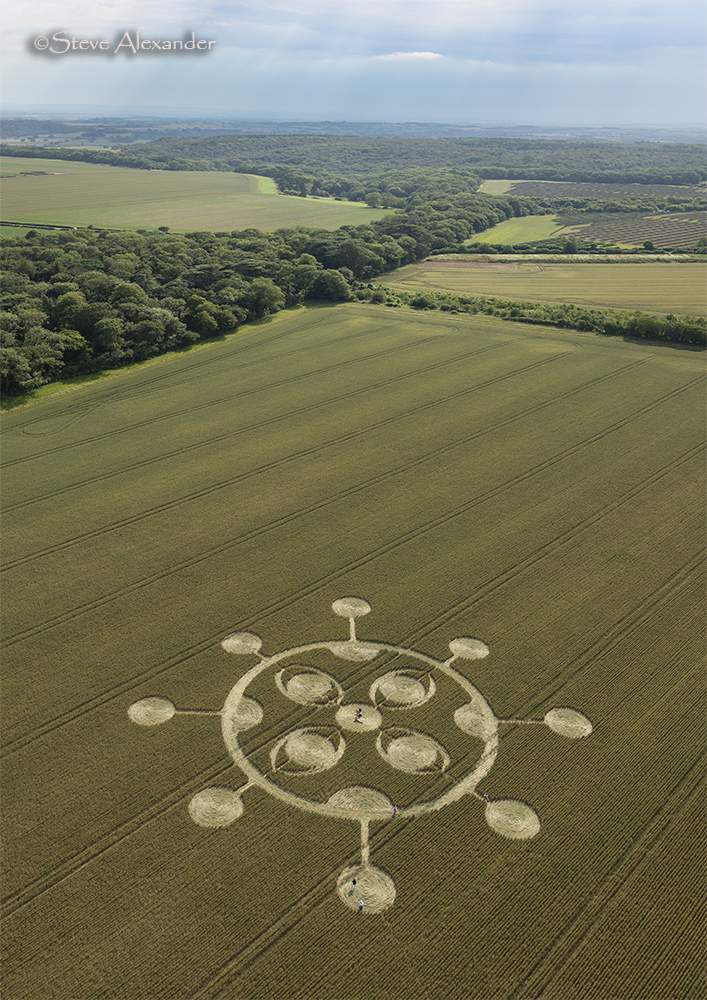
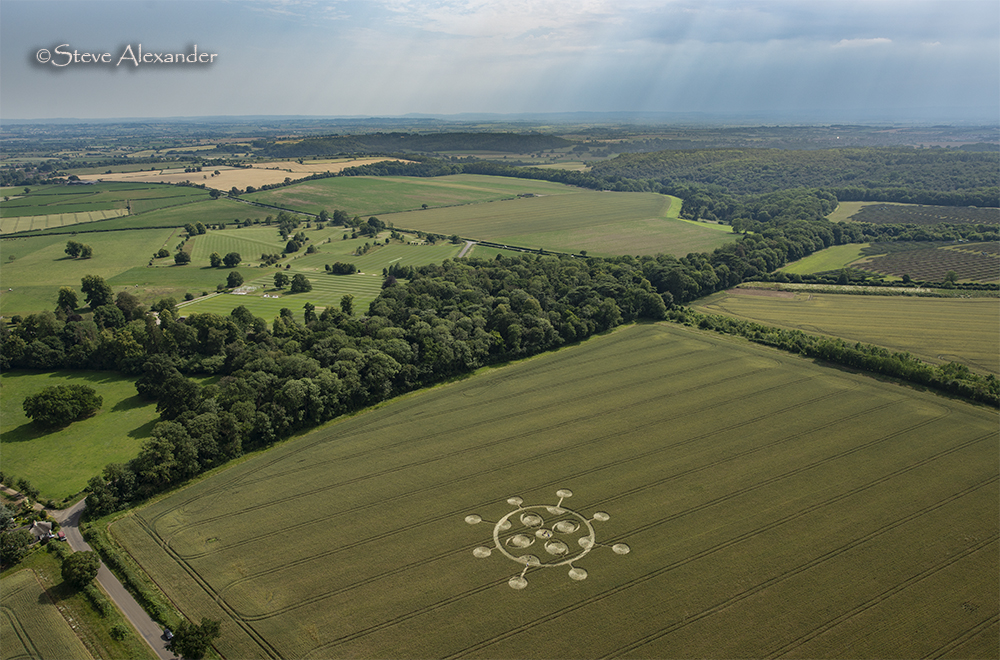
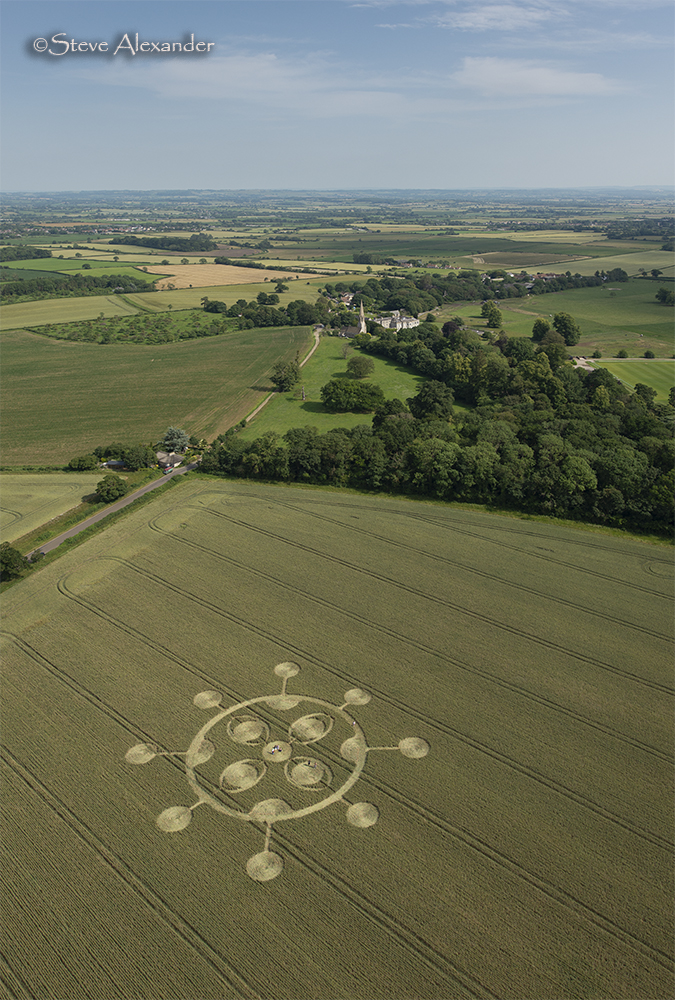
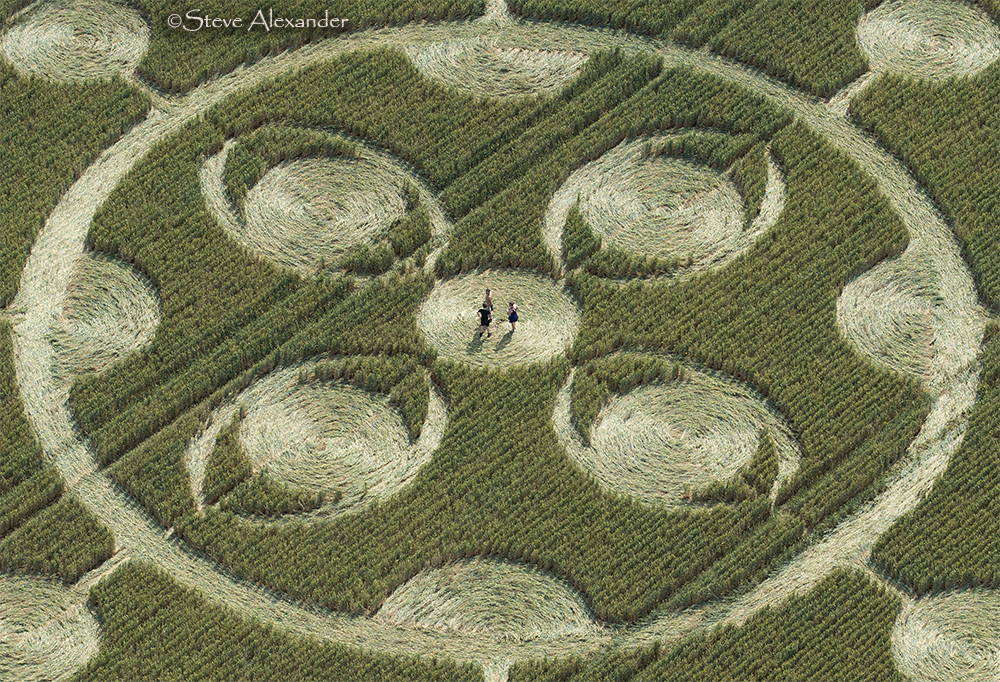
Image Licencing
We can supply high resolution images of many of our photographs and the sky is the limit as to what they can be used for! Choose from our extensive library or contact us to commission aerial photography for your project.
Geometry Gallery
I was rather sceptical when the first photo was shared. It looked poorly designed, poorly executed, and poorly integrated into the landscape—almost as if it had been designed in a hurry. In some ways it still does, but now that I understand the design better, I am starting to warm to it.
It's quite a contrast to the exceptional clarity of the previous designs. I think I expected that trend to continue, and when this formation deviated from the pattern, my initial reaction was scepticism. But we all love the underdog, so let's take a closer look and start drawing.
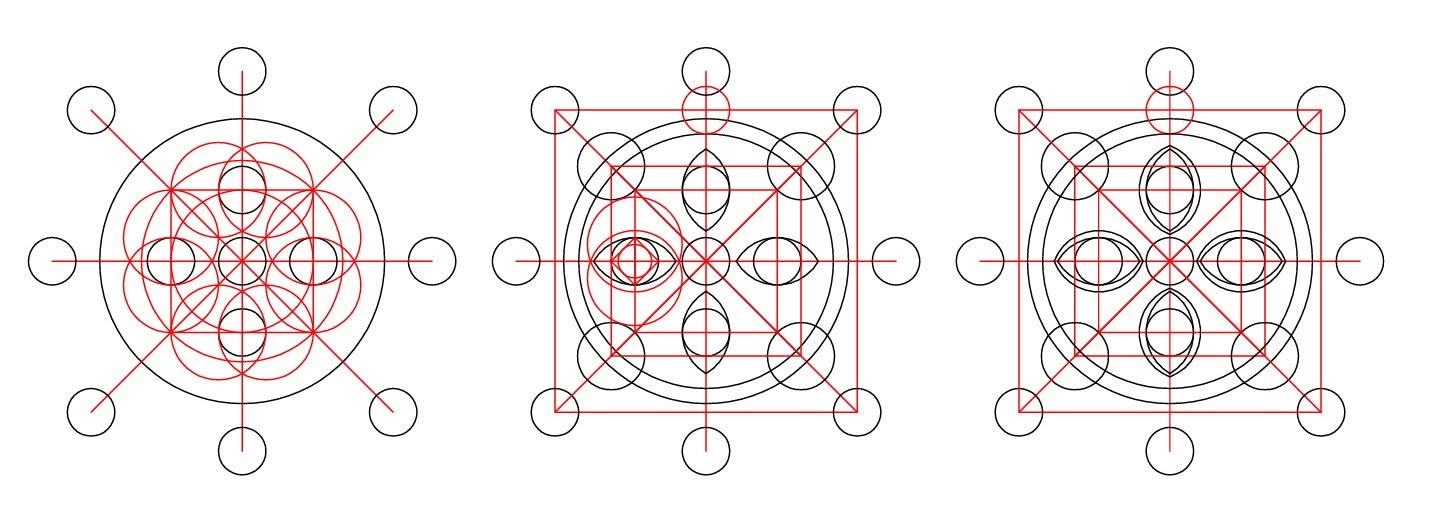
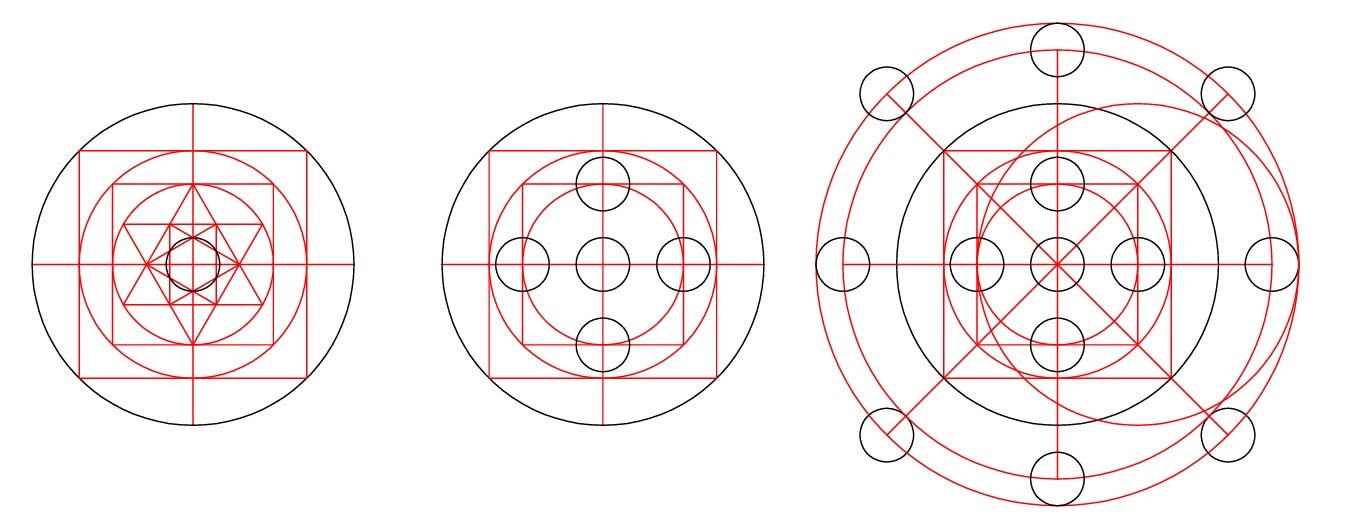
Begin with two nested squares inside the perimeter circle. Two nested hexagrams within the inner circle will give you the central flattened unit circle. Copy that circle outward as shown. This will establish the central circles of the eyes.
From the eyes, draw a circle centred on one eye with a radius tangent to the opposite eye circle. This determines the placement of the lateral circles. Note that they are not all equidistant from the centre—a feature shared with the Ilchester formation from April 4.
A square placed within the outermost of these circles will help you find the inner radius of the perimeter ring by using the unit circle placed on top of that square.
The eye shape is derived from a vesica piscis around the central eye circle. I love how naturally these circles sit within the square you started with. The outlines of the eyes can be found by moving the centre point of the circles slightly inward—perhaps by the inner radius of a square—without changing the radius of your compass.
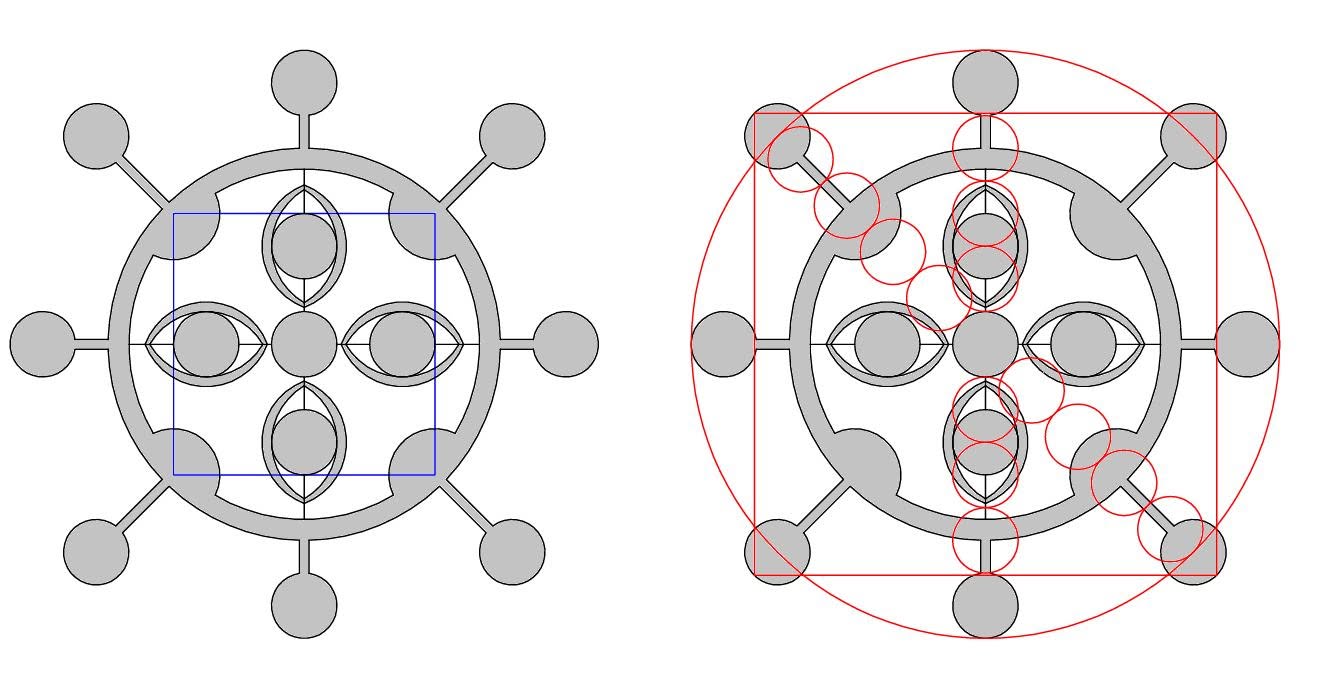
The semicircles on the inside of the perimeter ring have their centre points on the corners of a square that envelops the eye circles.
Because it borrows elements from almost every previous formation this season without fully integrating them, the formation stands out as a kind of lumbering Frankenstein. That may reduce its "snuggle factor", but it greatly increases its likability. We can relate. We all feel like the Neanderthal in a room full of elves from time to time.
I want to emphasise this because of the other formation that appeared near Kingweston earlier, on May 10. I mentioned then that it felt like a younger, less mature sibling of the formation at Alfred's Tower. This is, of course, just my own interpretation; there is hardly any objective truth to it. But I enjoy how these two formations, appearing in close proximity to one another, seem to share a similar character.
The semicircles on the inside of the ring have their centre points midway between the inner and outer radii of the ring. If we calculate the total area of standing crop within the ring and convert that value into a square (shown in blue), the corners of this square coincide with those centre points. I am always blown away by that kind of harmonic relationship. How would you even begin to design something from such a premise?
The formation as a whole has a diameter of either nine or ten unit circles, depending on which axis one chooses to measure. The squared circle we can derive from this shows that the circle has a circumference of 9 × π = 28.2743. The square, meanwhile, has a circumference of 10 × 0.5√2 × 4 = 28.2843, or 99.96% of the circle's circumference—which is remarkably close.
In his brilliant 1967 book, The Secrets of Ancient Geometry (nobody called it Sacred Geometry back then), Tons Brunes argued that one of the earliest practical uses of geometry may have been the observation that a cross ten feet in diameter creates a square with a seven-foot side. The discrepancy is negligible. Any other dimensions would leave roughly half a foot to spare, but seven and ten work beautifully together, creating a lunar calendar (4 × 7) with the mnemonic advantage for illiterate people of using the same number as the fingers on one hand—or the toes on one foot.
This is probably not directly related to the crop circle, but it's the sort of thing that's great for boring the heck out of other people. In a room full of elves, be the Neanderthal—that's what I say.
You can read read more of Peter's excellent work on his Facebook Page Geometry of the Crop Circles.

Date
21.06.2026

Crop
Wheat

Visiting
Location details: Google Maps Link OS Grid Ref: ST 52135 31746. What-three-words: tech.unfilled.suitcase
DO NOT ENTER THIS FIELD - at the request of the farmer.
Further Reading
Find out more on the websites below: